


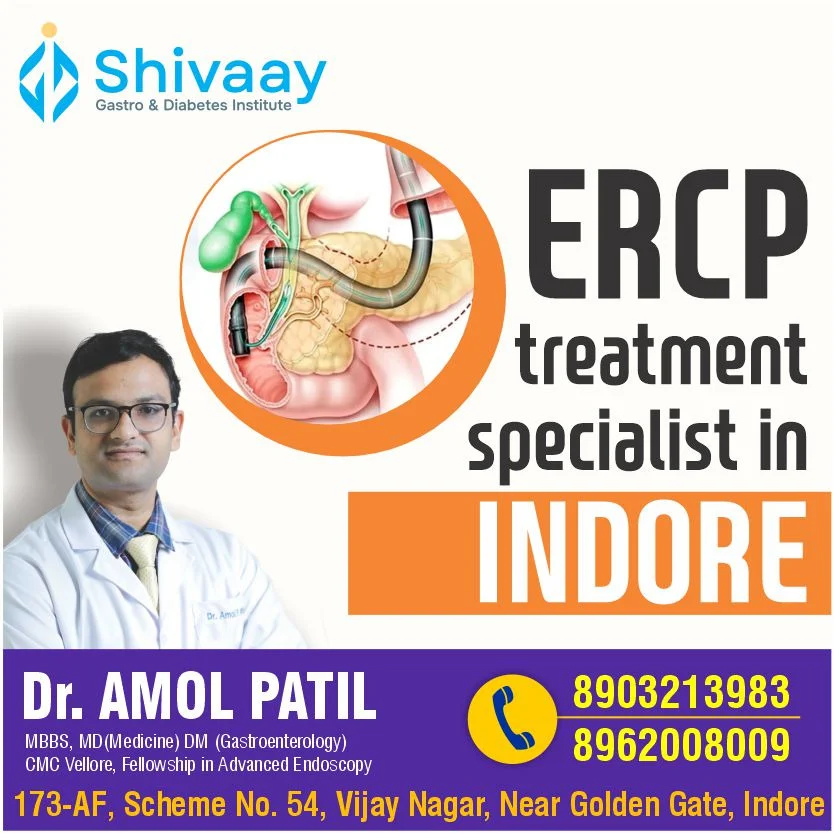
ERCP Treatment Specialist in Indore: Advanced Care for Bile Duct and Pancreatic Duct Problems
Persistent upper-abdominal pain, jaundice, fever, unexplained liver-test abnormalities, or blockage in the bile duct may require specialised evaluation. In selected cases, a gastroenterologist may recommend ERCP to identify and treat conditions involving the bile ducts or pancreatic duct.
Patients searching for an ERCP Treatment Specialist in Indore should understand what the procedure involves, why it may be advised, how to prepare, and what to expect afterward. ERCP is not a routine screening test. It is generally used when imaging or symptoms suggest a problem that may need endoscopic treatment.
At Shivaay Gastro & Diabetes Institute, patients can consult Dr. Amol Patil for assessment of digestive, liver, biliary, and pancreatic conditions in Indore.
What Is ERCP?
ERCP stands for Endoscopic Retrograde Cholangiopancreatography. It combines upper gastrointestinal endoscopy with X-ray imaging to examine and treat problems affecting the bile ducts and pancreatic duct. During the procedure, a flexible endoscope is passed through the mouth into the stomach and the first portion of the small intestine. Contrast material is then introduced into the relevant ducts so that they can be viewed through X-ray imaging.
Unlike tests that only create images, ERCP can also allow the specialist to perform treatment during the same procedure. Depending on the diagnosis, the doctor may remove a bile duct stone, widen a narrowed opening, place a stent, or collect tissue samples.
The decision to perform ERCP is made after reviewing symptoms, medical history, blood tests, and imaging findings.
When May ERCP Treatment Be Recommended?
An ERCP procedure in Indore may be considered when a patient has a suspected obstruction, narrowing, leakage, or stone involving the biliary or pancreatic system.
Common reasons may include:
ERCP may be used to open narrowed or blocked bile ducts and place a small stent to help keep the duct open.
A patient may first undergo ultrasound, CT, MRI, MRCP, blood investigations, or another endoscopic test. ERCP is generally recommended when treatment is likely to be needed rather than solely for routine diagnosis.
Symptoms That May Indicate a Bile Duct Problem
Symptoms vary according to the cause and severity of the blockage. Some patients experience sudden discomfort, while others develop gradual changes.
Medical evaluation may be necessary for:
Severe abdominal pain, fever, jaundice, confusion, faintness, or persistent vomiting requires urgent medical assessment. These symptoms should not be managed only through home remedies.
How Can ERCP Help Remove Bile Duct Stones?
Gallstones may form inside the gallbladder and later move into the common bile duct. When a stone becomes trapped, it can obstruct bile flow and may lead to pain, jaundice, infection, or pancreatic inflammation.
During therapeutic ERCP, the doctor may make a small controlled opening at the duct outlet, known as a sphincterotomy. Special instruments may then be used to extract the stone. In some cases, a temporary stent may be placed when complete drainage or stone removal cannot be achieved immediately.
Endoscopic sphincterotomy and stone extraction are established therapeutic applications of ERCP, although the expected benefit and risk must be assessed for each patient.
Seeking a qualified bile duct stone treatment specialist in Indore is important because the treatment plan depends on the stone’s size, number, position, associated infection, and the patient’s overall medical condition.
What Happens During an ERCP Procedure?
The exact process can differ based on the hospital, clinical condition, and treatment required. A typical procedure includes the following stages.
Pre-Procedure Assessment
The healthcare team reviews medical history, previous reports, allergies, pregnancy status, existing illnesses, and current medicines. Particular attention is given to blood thinners, diabetes medicines, and drugs that may affect sedation or bleeding risk.
Sedation and Monitoring
Medication is generally given to help the patient remain comfortable. Heart rate, breathing, oxygen level, and blood pressure are monitored during the procedure.
Endoscope Placement
A flexible endoscope is passed through the mouth, oesophagus, stomach, and into the duodenum. The procedure does not involve an external abdominal incision.
Duct Examination
A thin catheter is guided into the bile duct or pancreatic duct. Contrast is introduced, and X-ray images help the specialist identify obstruction, narrowing, leakage, or stones.
Therapeutic Intervention
Depending on the finding, the specialist may:
Recovery Observation
After the procedure, the patient is monitored until the effects of sedation begin to wear off. Some patients may be discharged on the same day, while others require hospital observation depending on their condition and the treatment performed.
How Should a Patient Prepare for ERCP?
Preparation instructions should be followed carefully to improve safety and visibility during the procedure.
The doctor may advise the patient to:
Medicines should not be stopped independently. Any adjustment must be made only after guidance from the treating specialist.
What Are the Benefits of ERCP?
The main benefit of ERCP is its ability to diagnose and treat selected duct-related problems in a single session.
Potential advantages include:
However, ERCP is recommended only when the anticipated benefit justifies its risks. It should not be viewed as a general digestive test.
Risks and Possible Complications of ERCP
ERCP is an advanced endoscopic procedure and may cause complications even when performed with appropriate precautions. Important risks include inflammation of the pancreas, bleeding, infection, perforation, reactions to sedation, and incomplete treatment. ASGE guidance identifies post-ERCP pancreatitis as a major adverse event for which preventive strategies may be considered based on individual risk.
The level of risk varies according to:
The treating specialist should discuss expected benefits, available alternatives, and individual risks before obtaining consent.
Recovery and Care After ERCP
A mild sore throat, temporary bloating, or abdominal discomfort may occur after ERCP because an endoscope and air are used during the procedure. These effects often settle with observation and appropriate medical advice.
Patients should follow the discharge instructions provided by the healthcare team. Guidance may cover eating, drinking, medicines, rest, driving, and follow-up appointments.
Urgent medical help should be sought after ERCP if the patient develops:
These symptoms can indicate a complication and should not be ignored.
ERCP Versus MRCP: What Is the Difference?
ERCP and MRCP are not the same procedure.
MRCP is a specialised MRI technique that produces images of the bile ducts, gallbladder, liver, and pancreatic duct. It is non-invasive and is often used to investigate a suspected obstruction.
ERCP is invasive but can provide treatment. It may remove a stone, insert a stent, improve drainage, or collect a sample.
In simple terms:
The gastroenterologist decides which investigation or procedure is appropriate based on the patient’s condition.
Choosing an ERCP Specialist in Indore
ERCP requires advanced endoscopy skills, careful patient selection, appropriate imaging support, and access to medical monitoring. Patients searching for an advanced endoscopy specialist in Indore may consider:
Dr. Amol Patil is a gastroenterologist with qualifications and training in medicine, gastroenterology, and advanced endoscopy, as stated in the provided clinic information.
Location-Based ERCP Consultation in Indore
Access to a nearby gastroenterology consultation can make investigation review, procedure planning, and follow-up more convenient. Patients looking for an ERCP doctor near Vijay Nagar Indore, gastroenterologist near Scheme No. 54, or bile duct specialist in Indore can schedule an assessment with their previous reports.
The clinic information shown lists the location as Scheme No. 54, Vijay Nagar, near Golden Gate, Indore. Procedure location, admission requirements, and availability should be confirmed directly while booking.
Frequently Asked Questions
1. Is ERCP painful?
Sedation and other medicines are generally used to keep the patient comfortable. Some people may experience temporary throat irritation, bloating, or abdominal discomfort after the procedure.
2. Can ERCP remove every bile duct stone?
Many bile duct stones can be treated through ERCP, but success depends on their size, number, location, anatomy, and associated complications. Complex stones may require additional procedures or another treatment approach.
3. Is hospital admission necessary after ERCP?
Some patients may return home after a period of observation, while others require admission because of infection, jaundice, pancreatitis, complex treatment, or another medical concern. The decision is individualised.
4. Can a biliary stent remain permanently?
Some stents are temporary and must be removed or replaced after a recommended interval. Others may be used differently according to the underlying condition. Patients should follow the specified stent-review schedule.
Book an ERCP Consultation in Indore
Jaundice, bile duct stones, pancreatic duct obstruction, recurrent upper-abdominal pain, and abnormal biliary imaging require timely specialist evaluation. ERCP can provide effective endoscopic treatment in appropriately selected patients, but the decision should follow a careful review of symptoms, reports, medical history, and possible alternatives.
For consultation regarding ERCP Treatment Specialist in Indore, bile duct stone management, obstructive jaundice, pancreatic conditions, or advanced endoscopic evaluation, contact Shivaay Gastro & Diabetes Institute to arrange an appointment with Dr. Amol Patil.
Contact Us Today to discuss your symptoms, review your reports, and receive a personalised evaluation and treatment plan.
| Tags: | #ERCP Treatment Specialist in Indore |


